Showing posts with label Kaffe Fassett. Show all posts

Wednesday, 6 April 2016

A Grand (Purple) Idea

Moroccan Mosaic: 2016  (Started:2011)
When it’s finally done, I think I’ll have to call this one the “Will I or Won’t I Quilt”….

Source: Quiltmania #68, p21
Now I look back, my quilt doesn't look anything like this at all!
It all started as a grand idea – an inspiration stemming from an old quilt (19th c_Piece 67) I’d seen in a QNM, then again later in a 2008 Quiltmania mag (#68 p21).  After lots of sketching and thinking, I gave up the idea of circles on squares (but not before cutting out a heap of fabric circles) and went with another idea I’d sourced from a new Kaffe Fassett book^^ I’d picked up in Camden ME (11/9/10), land of the real windjammers.  Kaffe’s quilt design is called Tilt and it’s a delicious field of colourful rectangles.  Those rectangles spoke to me.

So, with the few leftovers from my already cut circles (damn!), I managed to scrape together enough pieces from my Purple Patch collection plus a few little extras from the stash to put together an interesting background  of rectangles.  The circles however looked insipid on it and I was really searching for “Something Flashy” so it was back to the drawing board for a (long, long) while. 

It was those wonderful paper pieced circles made from scraps (Circles of Fun) pattern that jolted me back to this quilt.  Some of the girls were working on a COF quilt in late 2013 and that inspired me to make scrappy but colour controlled circles which would float on top of my restrained rectangles.  Wow!   It worked and saved the quilt from being wholesome, predictable, and a tad boring even. 

So here we are in early 2015, still piecing this top.  Only the borders to go now!  On reflection, isn’t it rather odd that I’ve yet again decided to branch out on a design your own quilt based on grandmothers fan.  Ring any bells?  Why yes, it’s those still unfinished silk stumbling fans….still crazy after all these years.  Perhaps I should rush out and buy a lottery ticket.

^^(Kaffe Fassett’s Simple Shapes Spectacular Quilts, Tilt p46.)

So here we are in March 2016 and finally I can call this one finished.  I used bamboo wadding and whilst it needled beautifully, it also fluffed a bit and needed fairly close stitching.  Not sure I'd go for it again.  For the record, I quilted this one using Perle #8 in three colours; a lush fuchsia, a rich dark purple and a cakky green (yes, that’s cakky! not khaki & I realise there’s a joke in there somewhere). 


Just for the Record:
Quilt Finished Size: 134 x 191cm
Block Sizes: 11.5 x 6.5”rectangles; 14” & 8.5” circles (diameter)
Cut in: 19 Feb 2011
Piecing Began: 14 May 2011
Pieced & Basted: 3 Apr 2015
Quilted: Hand 2015-16
Quilt Type: Interpretation of Traditional Quilt
Quilt Finished: Mar 2016
Exhibited: No
Collection: Home# 052
Pattern Name: Own Design
Pattern Source: Background - Kaffe Fassett & Wheels - Sue Ross
Fabrics Purchased: Purple Patch
Fabric Design: Purple Patch Collection & Kaffe Fassett
Fabric Style: Modern
Materials Type: Printed Cottons
Wadding Type: Bamboo
Backing: Pieced using left-over remnants

Thursday, 26 March 2015

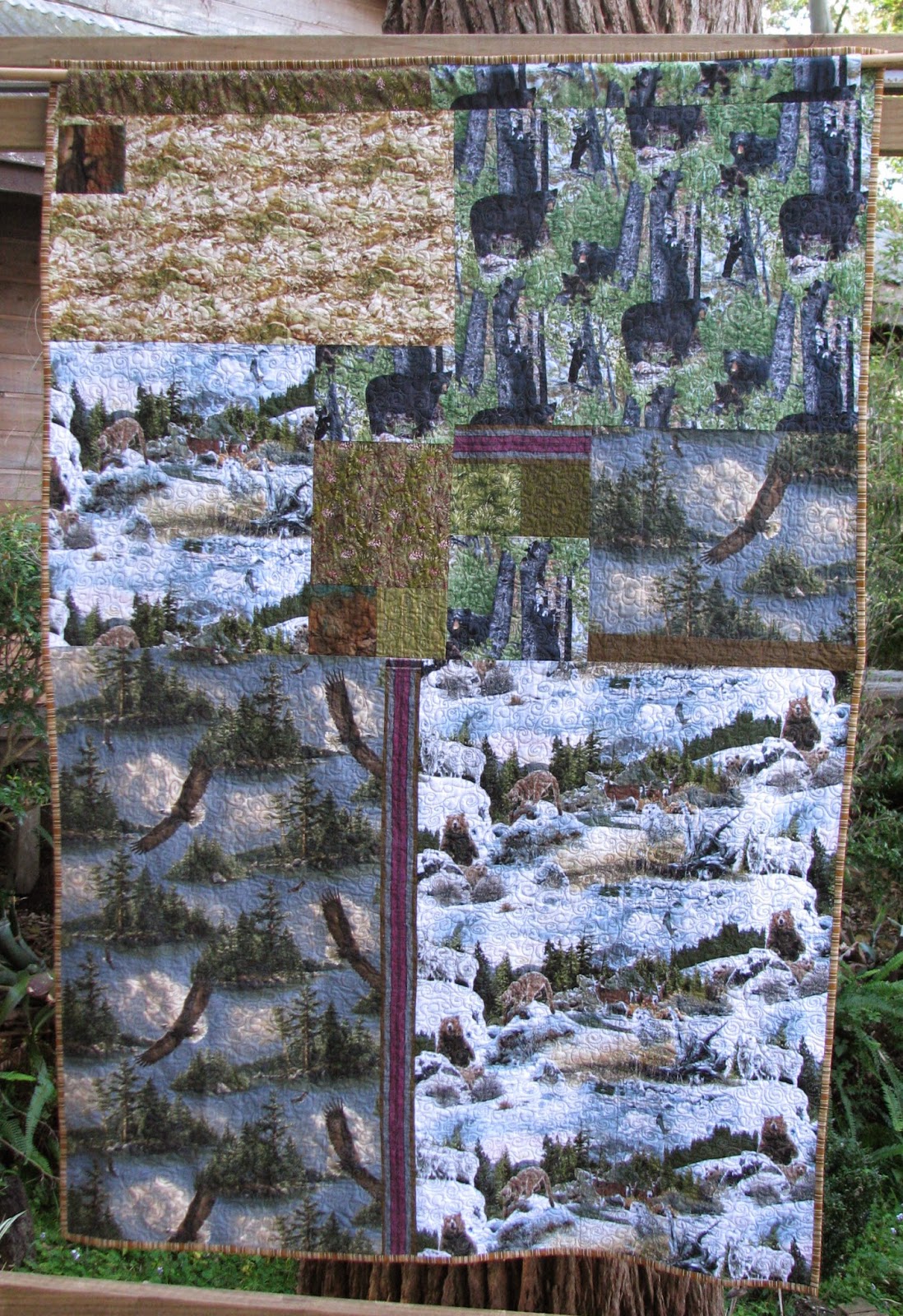
Bears in the Wild

Arcadia, Maine: 2011


Inspired after my efforts with the New York Quilt (it was quite the feverish high!), I quickly took up another stack of memento fabrics I’d purchased in Bar Harbor ME whilst on a trip through the Arcadia National Park (7/9/10).  This trip has special memories.  I was on walking sticks having landed heavily on (and badly twisted) my ankle a few days prior.  We’d also just ducked out of the way of Hurricane Earl and rather more pleasurably, eaten lots of freshly cooked lobsters. 

Despite being walking (just) wounded, I was determined, like a moth to a flame, to get into Fabricate if only to buy myself some quilting magazines.  To aid recovery, I assured Cap'n Doubtful.  In this lovely shop, I discovered some delightful fabrics that shouted “Maine” and I knew they would make up into a wonderful travel memento. 

Back home, I set about selecting a pattern of squares.  Based on my previous success with Kaffe Fassett’s designs, I found an energetic pattern made up of 6 squares.  (Jewel Squares, Kaffe Fasset “Patchwork”, 1997 p.138).  I fussy cut the squares to showcase the best of each design and then pinned them the next day at my regular Randwick meeting.  From there, it didn’t take too long to sew them up into a nice small-ish wall hanging.

Quilting design of waves, wind & mist

Back pieced to use up left-overs
I never did see any bears or even get moose-d but sought solace at Fabricate, 52 Cottage Street, Bar Harbor ME.  It all worked out for the best. The Cap’n would never have shared his cabin well with a bear for a guest… 

(Please note again, this is not an exact replica of Jewel Squares, I simply used the pattern piece sizes to construct my own arrangement of squares.)


And one for the photo album too.
Northeast Harbor, Maine
Just for the Record:
Quilt Finished Size: 114 x 168cm
Block Sizes: 2, 4, 6, 8, 10 & 12 inch
Cut in: 15 Apr 2011
Pieced & Basted: 2011
Quilted: Machine 2011
Quilt Type: Modern
Quilt Finished: 2011
Exhibited: Australia Day, 2013
Collection: Home#0 54
Pattern Name: Jewel Squares p138
Pattern Source: Kaffe Fassett, “Patchwork”, 1997
Fabrics Purchased: Fabricate, Bar Harbor ME
Fabric Design: Local Animals & Fall Foliage
Fabric Style: Travel Memento
Materials Type: Printed Cottons
Wadding Type: Cotton
Backing: Pieced using left-over remnants

. 

Monday, 23 March 2015

Beep! Beep! It’s New York City

East River Hot House: 2012  (Started: 2011)
On display, Australia Day 2013
I purchased some memento fabrics whilst on a shopping trip with Annette in NYC’s Textile District (30/9/10).  We hadn’t seen each other since our Delhi days and it was a fun catch up & craft trip in one.  Aside from rummaging through heaps of button & bead shops, we discovered two quilting fabric sources, City Quilter & Purl Soho. We were Shopping...in New....New York.  Yaaaaaay!

This quilt then is all about the fabrics.  I needed a design that showcased their lively character so, chopping them up into tiny bits seemed almost sacrilegious.  Those special NY themed fabrics!!   It was back to the books for a bit of inspiration, and who better than Kaffe Fassett.  I settled on squares from his Morning Garden Quilt.  (Kaffe Fassett “Kaleidoscope of Quilts” 2006 p60.) 

Back View
Built on a base of 3 squares, the largest being a big 9”; medium 6” and the smallest 3” (finished), this quilt cut up quickly and sewed even faster.  Perfect!  Then it was on to quilting.  I chose to design my own loose pattern of ginkgo leaves, a favourite street tree though out New York.  I imagined crusty brown leaves blowing in autumn winds through romantic Central Park .  Ah, dreaming again!  So after a regimen of 4 bobbins a day for 2 solid days quilting (and that was just a ¼ of the quilt), it was finally done and ready to hang.

(Please note, this is not an exact replica of Morning Garden Quilt, I simply used the pattern piece sizes to construct my own arrangement of squares.  Does that make it a copy?  Good question and one to consider in another post – on another day…)

Quilting Design
Just for the Record:
Quilt Finished Size: 156 x 230cm
Block Sizes: 9, 6 & 3 inch
Cut in: 18/19Mar 2011
Pieced & Basted: 2011 & 12
Quilted: Machine Feb 2012
Quilt Type: Modern
Quilt Finished: 2012
Exhibited: Australia Day, 2013
Collection: Home# 053
Pattern Name: Morning Garden Quilt
Pattern Source: Kaffe Fassett “Kaleidoscope of Quilts” 2006 p60.
Fabrics Purchased: City Quilter & Purl Soho, New York
Fabric Design: City & USA designs
Fabric Style: Modern Memento
Materials Type: Printed Cottons
Wadding Type: Cotton
Backing: Pieced using left-over remnants


If you’re looking for quilting supplies in NYC then
  • City Quilter is located at 133 West 25th Street; and
  • Purl Soho can be found at 459 Broome Street.
  • (City Quilter even had these lovely printed fabric postcards that I couldn't help but use as my quilt label.

Saturday, 17 January 2015

Getting Shirty

Tailor’s Choice, Shankar Market: 2009  (Started: 2004)
Interestingly, I've just noticed those off-centre squares. Wow!  I see why it's
recommended to stand well back from or take a photo of your quilt in the design phase!
I was attracted to this quilt which enabled me to make use of various high quality shirting fabrics available in Delhi, India.  The quilt reminds me of the many neighbourhood tailor shops with machines, electric and treadle, and all impossibly ancient. This quilt speaks of a preference for handmade designs, beautiful fabrics and made to measure quality.

I liked the simplicity of the design with its blue and white stripes but wanted to add just smidge of red for some oomph.  Squares were cut from each pattern and then recut in triangles.  The pattern is more difficult than it looks and certainly tested my skills.  Firstly, remembering to set out the design on flannel before sewing* and then accurately stitching ¼ inch seams (which of course I didn’t and had to fudge a bit – as we all do!). 

The fabrics were sourced and purchased with Annette & two other ladies from the Garam Masala Quilters in Delhi at Shankar Market.  We had seen Kaffe Fasset’s design in “Passionate Patchwork” and decided Delhi’s bounty of shirting fabrics would be well suited to it. I recall that we purchased a metre each of the required number of fabrics, adding a few extras that we personally wanted to include in our design e.g. a splash of red.

The fabric store assistants were most helpful (all men; tailoring is taken most seriously) and we could have come home with a great deal more - the choice of stripes, even in this limited colourway, was fantastic!

Being greedy (like any kid in a lolly shop), I also purchased a collection of darker, autumn colour stripes to eventually make up (maybe) into Kaffe’s Optical Squares - also in Passionate Patchwork…. 

The design finished a little narrow for my liking and it took some time to decide on side panels – width and style of fabric.  I was desperate to put in some Chinoiseries style blue and white but thankfully, friends talked me into sensibly using plain blue bands. 

Pieced backing - good for using up left-overs...
I pieced the backing from remnants and an old blue & white cotton skirt I made (actually, pieced) years ago but had never worn.  A few florals were added to give the back a bit of zing.

The quilt was machine pieced then hand quilted sashiko style using thread purchased in Japan on a trip with Yvonne (2000).  The result has an essential “beach house” vibe.

* A lesson in designing with colour - Kaffe Fasset Workshop in Sydney 2000 

On Exhibition - Australia Day 2010
Just for the Record:
Quilt Finished Size: 145 x 217cm
Block Sizes: 3 sizes: 9”; 6”; 3”various
Cut in: 2004 Delhi
Pieced & Basted: 2006 Kathmandu Machine
Quilted: 2009 Sydney
Quilt Type: Own Design
Quilt Finished: 2009 Sydney
Exhibited: Australia Day, 2010
Collection: Home# 048
Pattern Name: Shirt-Stripe Boxes p130
Pattern Source: Passionate Patchwork, Kaffe Fasset
Fabrics Purchased: Shirting 1200Rs each bundle; Shankar Market, India 2004
Fabric Design: Shirt Stripes
Fabric Style: Men’s shirting
Materials Type: Garam Masala Quilters & friends
Wadding Type: Cotton
Backing: Pieced using left-over remnants   
Wednesday, 19 March 2014

Luminary Assets

Rosy Autumn: 2010  (Started: 2000)
Our King Parrots felt right at home
We (four of our RLI group) had somehow lucked in with a place for a day’s workshop with colour master extraordinaire, Kaffe Fassett.  We assembled (nervously) at the Kirribilli Neighbourhood Centre on 18th June 2000, with great hopes that he could teach us his best colour secrets in only a few hours. 

Our homework had simply been to assemble a collection of blowsy prints in either autumn or spring colourways.  We had even been told not to be afraid to tea dye various selections to have them “fit” better and  warned off overly “matching” our selections too.  I chose a tawny rose selection - autumn colours that I probably wouldn’t have normally selected in a combo of bright reds, rusty oranges and eucalypt greens.

The pattern, Tawney Rosy, was in Kaffe’s book “Patchwork”.  It involved placing our fabric selections into a simple formula that allowed us to develop our eye for colour selections. (I’m not sure I was really convinced it would work at the start!)
  • Fabric A: bold large scale florals
  • Fabric B: smaller scale prints
  • Fabric C: neutrals including stripes, plaids, tone prints or toiles
These fabrics were then chopped up into different sized blocks (see his book for the recipe!) to be ready on the day to play.  
An explosion of colour
And play we did!  If Kaffe thought you needed another fabric to “improve” your set, he would happily delve into a neighbour’s stockpile.  We learned how to share – and consider our selections – shaking up the usual suspects.  Both Kaffe and Brendon Mabley made the day very challenging yet most rewarding.  By the end of it we had a top pinned (to a flannel sheet) ready to machine. Go Rinny!

I finally had my quilt basted by Dec 2001 but it took me a couple of machine quilting classes (Lee Cleland & Kim Bradley) and lots of practice to give me the confidence to take on the quilting.  It was some 9 years later, (2010) before I felt that I had the right pattern & technique to finish!   Now I look back, I believe one thing that held me back was that no matter what I did to the quilt, I felt it was always going to be a KF quilt.  Eventually I chose a simple an autumn leaf design (that I made up myself) and even managed a decorative label to finish it off. 
King Parrots - two males, one a rare albino; 

This is my label.  I guess you knew that!
Just for the Record:
Quilt Finished Size: 169 x 172cm
Block Sizes: 9”; 4.5”; 3”
Cut in: 2000
Pieced & Basted: Machine 2001
Quilted: Machine 1995
Quilt Type: Workshop
Quilt Finished: 2010
Exhibited: Dangar Island Australia Day 2011
Collection: Home# 038
Pattern Name: Kaffe’s Nine Patch, Rosy Autumn
Pattern Source: Kaffe Fassett’s “Patchwork” p68
Fabrics Purchased: Group Choice
Fabric Design: Prints & Plains
Fabric Style: Cotton
Materials Type: Cotton
Wadding Type: Thin Poly Batt
Backing: Cotton


Lessons Learned:
I still can’t believe how fortunate we were to get places at a workshop on mastering simplicity, colour and style with this amazing textile artist and his clever assistant. You just couldn’t do it now!  It is always worth the effort to challenge your perceptions, understand your limitations and learn from master artists.  I can see the true value in experiencing shared learning.  An experience not to be forgotten!

Thursday, 6 March 2014

More Desert Island Reading

Books I can’t be Without continues:

101 Fabulous Rotary-Cut Quilts
Judy Hopkins & Nancy J. Martin, 1998, Martingale & Company, Bothell, Washington

I've just noticed that 101 seems to be my favourite number!  By the time I purchased this book I was well and truly obsessed with patchwork and quilting.  Whilst I still loved hand piecing and quilting, I realised that my machine (dear old Ernie Elna) was my best buddy and, along with the rotary cutter, my only way forward.  Of course, some quilts still demand “slow” making but there were times in my increasingly busy life when I needed a quick fix.  I was occasionally making clothes too, so it seemed only natural to do more than just machine borders and bindings on to my quilts.

Hopkins & Martin had written other books but I couldn’t wait to get my little fingers on this big bruiser.  It has become, and still is, my most favourite reference book of all.  If I want a basic pattern, it’s usually here.  The illustrations are terrific, the measurements always exact and I’ve never yet had a dud – and trust me, I’ve made quite a few from this book!  Yes, the patterns are classic but it only takes a moment to add, subtract and massage and before you know it, another new creation!  Mind you, I know I prefer to make quilts that are basically geometric designs, so that helps.

When I went to live in India in 2004, I took, aside from my machine, 2 suitcases.  One with clothes and one with quilting supplies (not fabric though, just a few UFO’s).  This book was the only one I took.  It was in the spirit of adventure – and proved a very valuable learning environment.


That Perfect Stitch: the Secrets of Fine Hand Quilting
Roxanne McElroy, 1998, The Quilt Digest Press, Chicago, Illinois USA

When it comes to hand quilting books, my choice was difficult but this one by Roxanne McElroy was a standout because it is almost a scientific evaluation of the hand quilting process.  If ever you want to improve your stitching, this is the place to come.  I particularly appreciated advice on batting choices for hand quilting and how better to position your hand to protect against repetitive strain.  I also made the decision not to buy a frame (I’d been wanting one for years) after reading this book, because I didn’t think it suited MY style of quilting.  This book is so worth the read, there is much to learn, and I refer to it time and time again.

I can’t leave the subject of hand quilting without mentioning Liuxin Newman (Perfect Hand Quilting without Pain, Thimblelady, Australia, 2003).  I did a hand quilting workshop with Liuxin a few years ago and it turned my quilting life around. I just love to use her thimbles; they are so perfect for the method she taught us.  Another plus was that I managed to use a hoop -finally! I’d always used one for embroidery but had found I had trouble quilting with one.  Now I wouldn’t quilt without one. 

So I guess the moral of the story is that it’s fine to know, understand & appreciate the theory, however well it’s presented, but it’s understanding your own needs and lots of  practice that makes the difference.     


Simple Shapes Spectacular Quilts
Kaffe Fassett, 2010, Abrahams, New York


What can I say!  The title says it all - simple shapes highlighting fantastic fabrics that are all about COLOUR.  Kaffe is definitely the colour master.  I could have chosen any of his books for my “fab” favourites.  His quilts are, each and every one, a lesson in colour play and I sometimes think that in the race to make all those quilts that dance in our heads, we miss taking a slow approach.  Perhaps by making our designs less complex, taking (lots of) time to explore colour options, and considering construction options, we too can get the message. This doesn’t mean that I copy, copy, copy.  But I do see how shapes and colour can be grouped and use this as a springboard to help me find the next rung on my learning ladder.

Well, reviewing has been lots of fun; the thinking hard but at last a vague notion of better understanding - myself and my motivations.  Why?  Well in the words of Melody Crust, “my best quilt is my next one”.